Hobart Street Art Walking Guide
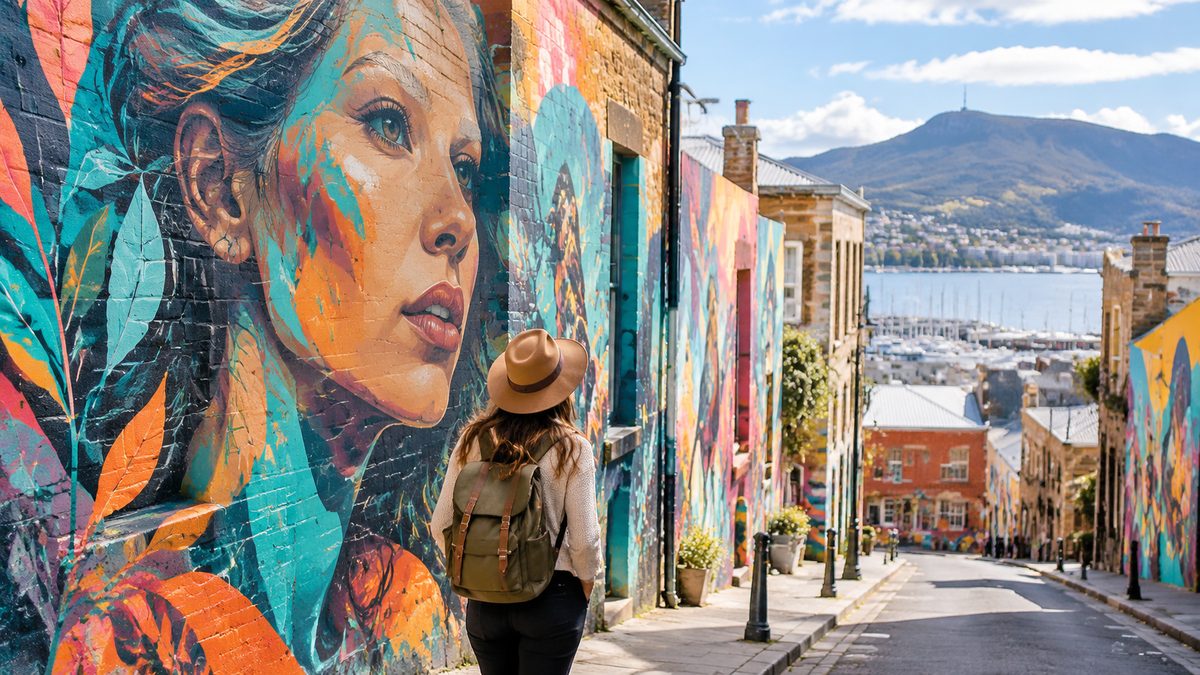
The best Hobart street art walk starts at Bidencopes Lane, crosses the central city and follows Elizabeth Street towards North Hobart. This route places Hobart’s best-known mural lane beside smaller works that are easy to miss. Allow about 90 minutes for the central route or two hours if you continue north. The exact artwork can change, so treat the walk as a way to explore living city walls rather than a fixed outdoor gallery.
Hobart’s compact centre suits this kind of walk. The main stops sit within a few city blocks, but the work is spread across lanes, shop walls, car parks and service areas. Looking down side streets matters as much as following the route.
Where should the walk begin?
Begin at Bidencopes Lane, reached from Liverpool Street, Hobart. It is the clearest starting point because several large works occupy a small space. You can slow down, adjust your eyes to the scale of the art and inspect details without covering much ground.
The lane takes its name from Bidencopes, a retailer once associated with the nearby building. Its current appeal comes from the concentration of painted walls. A single Mural may fill a building face, while smaller marks sit around doors, pipes and loading areas. Step back before taking a close look. Large works often make more sense when viewed from the opposite wall.
Enter during daylight. Lanes contain uneven surfaces, delivery activity and vehicle access. Keep doorways clear and stay alert when standing in the road for a photograph. If a work is behind temporary fencing or close to an active loading zone, view it from a safe distance.
How do you follow the central city route?
From Bidencopes Lane, return to Liverpool Street and walk east through the city centre. Check the short lanes and visible side walls along the way, then turn towards the blocks around Elizabeth Street and Melville Street. Continue north on Elizabeth Street for the optional North Hobart extension.
A simple order keeps the walk easy to follow:
- Explore both ends of Bidencopes Lane.
- Return to Liverpool Street, Hobart and scan the upper walls as you move through the central blocks.
- Turn through nearby lanes rather than staying on the main shopping strip.
- Work towards Melville Street and the northern end of the CBD.
- Follow Elizabeth Street into North Hobart if time and energy allow.
This is a flexible route, not a promise that every marked wall will remain unchanged. Paint is covered, buildings are repaired and new work appears. Construction can also block a lane for weeks. A missing piece does not mean the walk has failed. The change itself shows how the city uses and reuses its walls.
What should you look for beyond the largest murals?
Look for scale, surface and setting. A polished commission on a broad wall has a different purpose from a small piece placed beside a drainpipe. Brick texture can become part of a face or pattern. Windows may frame part of an image. Faded paint can reveal an older layer below.
Graffiti and commissioned art can appear within metres of each other, but they are not the same thing. Graffiti may centre on a name, letter style or repeated mark. A commissioned work is usually made with the property owner’s consent and may respond to a set theme. Some artists work across both forms, which makes a strict visual split difficult. Permission and context often tell you more than style alone.
Urban art is another broad label. It can include murals, paste-ups, stencils, installations and painted utility surfaces. Public art is broader again. It may include sculpture, memorials and permanent civic commissions that were planned for a public setting. On this route, these forms sit together, but they come from different approval processes and may have very different expected lives.
Do not judge a work only by how well it fits a phone screen. Look at how it changes the street. Ask whether it draws attention to a blank wall, responds to the building or creates a link with nearby businesses. That relationship is often the most interesting part.
Why is Bidencopes Lane the strongest single stop?
Bidencopes Lane gives visitors the highest visual return for the least walking. Several painted surfaces can be seen within one short lane, making it useful for people who cannot complete the full route. It also shows why lanes work well for large wall art. The enclosed space creates a strong field of colour, yet the close viewing distance reveals brush marks, spray lines and surface damage.
Spend at least 15 minutes here. Walk through once without taking photos. On the second pass, examine the lower corners, door surrounds and changes in paint where one image meets another. These details help separate the artist’s planned work from later marks and repairs.
Photography is easiest when direct sun is not cutting across the wall. Bright sun can place half a work in glare and the other half in deep shade. Overcast light often records the colours more evenly. Early visits also reduce the chance of delivery vehicles blocking a wall, though access needs change from day to day.
Is North Hobart worth adding?
Add North Hobart if you want to see art within a working dining and retail strip rather than a compact lane. Continue up Elizabeth Street from the CBD. The walk becomes less concentrated, so expect gaps between pieces. Check side walls, rear access points and the edges of car parks while respecting private property.
The change in setting is useful. Central Hobart work often competes with large shops, signs and heavy foot traffic. Farther north, painted walls can sit beside smaller businesses and older building fronts. This gives each piece more room, even when the artwork itself is modest.
The extension also turns the walk into a better study of place. You can see how art changes as the street shifts from a central shopping area to a neighbourhood strip. Allow another 30 to 45 minutes for the outward walk and viewing time. Return by the same street, use a public bus or stop in North Hobart and make it the end of the route.
What route mistakes waste the most time?
The first mistake is searching only at eye level. Many larger works begin above awnings or occupy upper storeys. Cross the street where it is safe and look back. This wider angle often reveals work hidden by signs and parked vehicles.
The second mistake is relying on an old image as if it were a permanent marker. Street art changes faster than a museum display. Save the street location rather than expecting an exact colour or character to remain.
The third mistake is following the wrong city result. Online searches can mix Hobart streets with mainland locations. Collins Street, Melbourne and Elizabeth Street, Melbourne are unrelated to this walk. Check that a listing names Hobart or Tasmania before adding it to your route. Hobart also has its own Elizabeth Street, which forms the natural path towards North Hobart.
The fourth mistake is trying to include too much of the city. Battery Point has historic streets, cottages and harbour views, but it is not part of the most direct street art route. Add it as a separate walk rather than stretching this circuit south and losing focus.
When is the best time to walk?
Walk between mid-morning and late afternoon, when the lanes are easier to inspect and businesses are active. Hobart’s winter days are short, so start earlier during the colder months. Rain can deepen wall colours, but wet paving and traffic reduce the value of stopping in narrow access lanes.
Weekday mornings may bring deliveries and trade vehicles. Weekend periods can bring heavier foot traffic near shops and cafes. Neither period is always better. Choose daylight, allow room for other people and avoid standing in vehicle paths.
Wear shoes suited to city paving. Carry a light rain layer because Hobart weather can shift quickly. A charged phone helps with navigation and photography, but a zoomed map cannot show whether a lane is temporarily closed. Treat signs, barriers and current street conditions as the final authority.
How should you photograph the artwork responsibly?
Take photographs from public space and avoid blocking doors, ramps or driveways. A lane remains a service area even when its walls draw visitors. Move aside when workers or vehicles need access.
Start with one image that shows the whole wall in context. Then record smaller details. This creates a more useful set of photographs than a tight crop alone because it preserves the relationship between the art and the building.
Credit the artist when a clear signature, plaque or reliable project record identifies them. Do not guess from style. If no credit can be verified, describe the location without assigning a name. Avoid touching, peeling or adding marks to any work. A paste-up that looks loose is still part of the piece until its maker or property owner removes it.
People may appear near popular walls. Wait for a clear frame where practical, especially if children are present. A public setting does not remove the need for care when publishing identifiable images.
How can you read the route as a record of Hobart?
Street art records choices about which stories receive space. Some works use local plants, animals or maritime themes. Others focus on pattern, portraiture or fantasy. The subject alone does not prove a local link, so use any nearby plaque or artist statement before drawing a firm conclusion.
The wall also carries evidence. Fresh paint may show a recent commission. Cracks, fading and covered sections reveal weather, repairs and new ownership. Temporary work can still shape how people remember a street. Its short life is part of the form rather than a fault.
The Hobart Field Guide treats the walk as observation, not a hunt for a fixed checklist. Notice who can see a work, how long people stop and whether the image changes movement through the lane. A successful piece may cause someone to enter a space they would otherwise pass.
For more local planning, use The Hobart Field Guide as a starting point for separate Hobart routes. Keeping the street art walk focused leaves time to look closely instead of rushing between distant sights.
What is the simplest plan for a first visit?
Set aside 90 minutes and make Bidencopes Lane the fixed point. Walk east along Liverpool Street, inspect nearby side lanes, move towards Melville Street, then choose whether to continue up Elizabeth Street. Keep North Hobart as an extension rather than a requirement.
If mobility or time is limited, visit Bidencopes Lane and one nearby central block. The compact version still shows the contrast between a concentrated mural site and art placed within ordinary city streets. Some lanes have uneven paving, narrow access and vehicle movements, so assess each entrance before proceeding with a wheelchair or pram.
Action takeaway: Save Bidencopes Lane as your start point, allow 90 minutes in daylight and follow Liverpool Street towards Elizabeth Street while checking every public side lane along the way.